Ha Long Bay for school trips — beyond landscape to learning and tourism systems
Ha Long Bay is one of the most commonly included destinations in Vietnam school trips, often chosen for its landscape and accessibility.
For many students, it is also one of the most familiar images of Vietnam — limestone islands rising from the water, caves shaped over millions of years, and a setting widely recognized as a UNESCO World Heritage Site.
Arriving on site does not replace that image. It complicates it.
A landscape shaped over time
Ha Long Bay’s karst formations are the result of long-term geological processes.
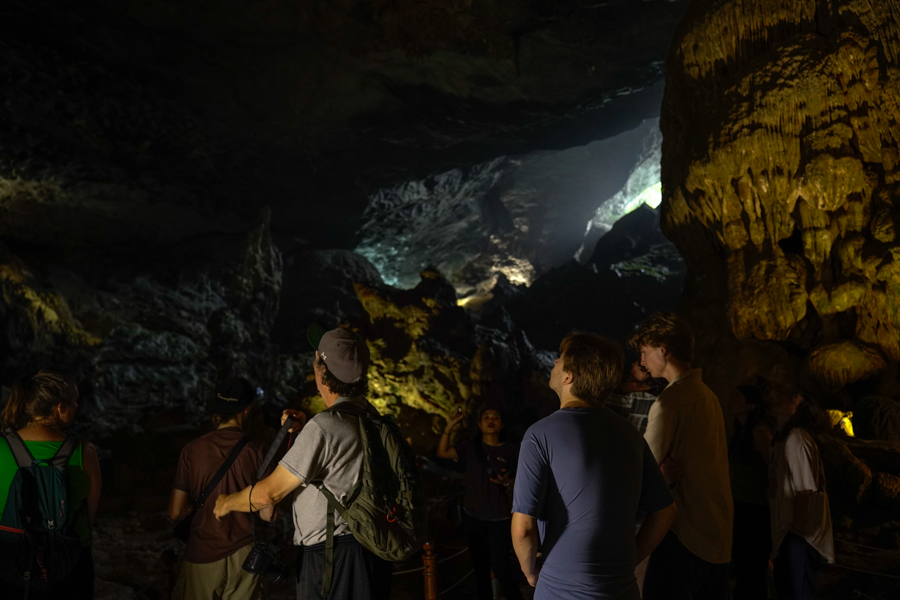
Limestone layers, formed in ancient marine environments, have been shaped by water and erosion into pillars, arches, and cave systems. Spaces such as Sung Sot, Dau Go, and Thien Cung caves provide visible entry points into these processes.
For students, these sites offer a way to observe geology not as diagrams, but as structures they can move through.

When scale changes perception
At the same time, Ha Long Bay is not experienced in isolation.
Cruise boats move continuously through the bay. Multiple groups enter the same cave systems. Pathways are defined, lighting is installed, and movement is guided.
For many students, this creates a different kind of question.
The landscape is still there. But the experience of it is shaped by how it is accessed.
Natural systems and managed environments
Caves such as Sung Sot or Thien Cung are often presented as natural wonders.
But they are also managed spaces.
Lighting affects how formations are perceived. Walkways determine where visitors can move. Entry points regulate flow.
This does not diminish their geological value. It changes how they are encountered.

The tension between preservation and access
Ha Long Bay exists within a balance that is not always stable.
On one hand, it is a protected landscape with significant ecological and geological value. On the other, it is one of the most visited destinations in Vietnam.
This creates ongoing tension:
-
how to preserve formations while allowing access
-
how to manage visitor volume without limiting experience
-
how to maintain environmental quality under continuous use
These are not abstract questions. They are visible in how the site is organized.
How Ha Long Bay fits into Vietnam school trips
In most itineraries, Ha Long Bay is included as a short but high-impact segment.
Students move quickly between locations — boarding cruises, entering caves, and returning within a limited timeframe.
Because of this, the value of the visit depends less on the number of sites covered, and more on how the experience is framed.
Without context, it can remain a visual highlight. With context, it becomes an entry point into understanding how natural systems operate under pressure.
What students take away
The most immediate impression is often visual.
But over time, another layer emerges.
Students begin to notice how access shapes experience, how infrastructure interacts with landscape, and how natural systems are maintained — or strained — under large-scale tourism.

A landscape that raises more than one question
Ha Long Bay is often presented as a place to see.
For educational programs, it becomes a place to interpret.
The geology is only one part of the experience. The rest lies in how that geology is encountered — through movement, management, and scale.
And in that interaction, students are not only learning about natural processes.
They are learning how those processes exist within a world where access, use, and preservation are constantly being negotiated.
For educators planning Vietnam school trips, Ha Long Bay is often included not only for its geological value, but as a case where natural systems and tourism pressure can be observed together.