Laos in school trips — learning through friction, history, and cultural context
Laos is not a typical entry point for school trips in Southeast Asia.
It does not present itself through scale, infrastructure, or obvious highlights. For many students, this creates an immediate sense of unfamiliarity — not just with the environment, but with how to navigate it.
This is where its value begins.
A context that does not immediately “make sense”
In cities like Luang Prabang and Vientiane, the structure of daily life is not always legible at first glance.
The pace is slower, but not necessarily organized around visitors. Public space feels quieter, interactions more indirect, and systems less visible compared to more developed urban environments.
Students often encounter small points of friction:
-
uncertainty in how to move through space
-
difficulty interpreting social cues
-
gaps in language or communication
These moments are not disruptions. They are part of the learning environment.
Cultural frameworks beyond the familiar
Understanding Laos requires moving beyond surface observation.
The country’s cultural foundations are closely tied to Theravada Buddhism and to older political and social structures, including the Mandala system — where power was historically distributed through overlapping centers rather than fixed borders.
This creates a different way of reading society.
For students, concepts such as authority, community, and identity do not always align with what they are used to. Rather than clear structures, they encounter layered relationships that require interpretation.
History encountered through its consequences
In Vientiane, sites such as the COPE Visitor Centre introduce the legacy of the Secret War.
Laos remains the most heavily bombed country per capita in history, and the presence of unexploded ordnance (UXO) continues to affect daily life in certain regions.
For students, this shifts how history is understood.
It is not presented only as past events, but as an ongoing condition — shaping land use, mobility, and community life decades later.
This creates a different kind of engagement with history, one that is grounded in consequence rather than chronology.
Religion as lived structure
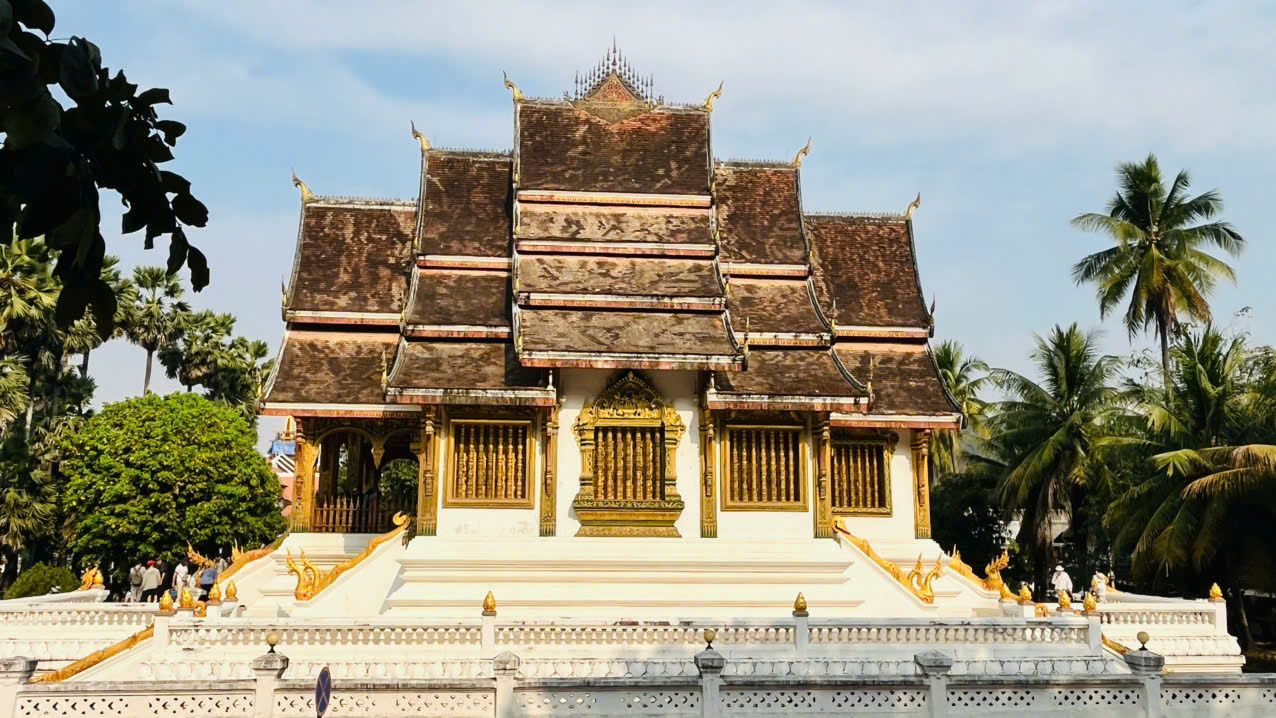
In Luang Prabang, religious life is visible but not explained.
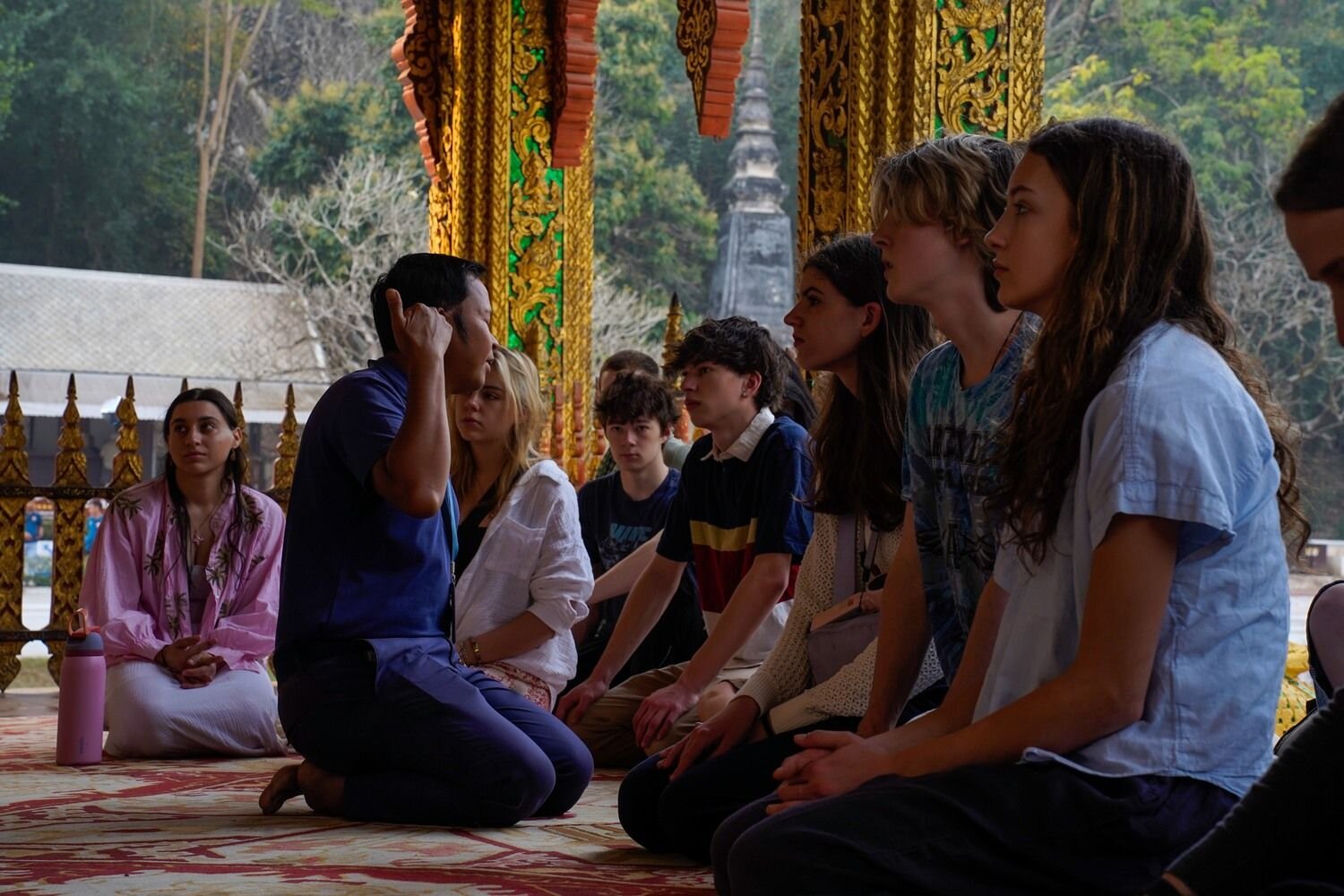
Morning alms-giving rituals, temple activities, and everyday practices take place without framing or interpretation. Students are not guided through these experiences in a structured way. They observe, adjust, and gradually begin to understand how they are meant to participate — or not participate.
This is not about learning religious doctrine.
It is about recognizing how belief is embedded in daily routines, and how space, behavior, and interaction are shaped by it.
How Laos fits into a school trip
In most programs, Laos — particularly Luang Prabang and Vientiane — is used as a segment where the pace shifts and the structure becomes less explicit.
Compared to more developed destinations, there are fewer predefined “learning moments.” The value lies in how students respond to the environment itself.
From an operational perspective, this requires a different approach.
Rather than filling time with activities, programs need to allow space for uncertainty, observation, and adjustment. What students take away depends less on what is delivered, and more on how they move through these moments of friction.
What students take away
The impact of Laos is not always immediate.
There are fewer clear highlights, and less external stimulation. But over time, students begin to notice changes in how they engage.
They become more attentive to context. They rely less on instruction. They start to interpret rather than react.
In many cases, the most significant shift is not in what they learn, but in how they approach unfamiliar situations.
A context shaped by friction
Laos does not simplify itself for visitors.
Its systems are not always visible, its history is not always directly explained, and its cultural logic is not immediately accessible.
For educational programs, this creates a different kind of learning environment.
One where students are not guided toward clear answers, but placed in a context where understanding has to be built gradually — through observation, interpretation, and engagement with uncertainty.
And in that process, learning becomes less about acquiring information, and more about developing the ability to make sense of what is not immediately clear.