Mangrove ecosystems in Mekong Delta school trips — understanding coastal systems in practice
In Mekong Delta school trips, coastal environments provide one of the clearest entry points into how environmental systems function.
Rather than learning about ecosystems through diagrams or definitions, students encounter them as living structures — shaped by water, soil, and constant change.
Mangrove forests, particularly in areas such as Bến Tre, offer a grounded way to observe these dynamics.
A coastal system shaped by tides and sediment
At the edge of the Mekong Delta, where river and sea meet, mangrove forests form a transitional zone.
Here, land is not fixed. It is continuously shaped by tides, sediment, and salinity. The environment shifts between freshwater and brackish conditions, creating a system that requires constant adaptation.
For students, this setting provides a different way of understanding ecosystems — not as stable categories, but as processes that are always in motion.
A closer look: Vàm Hồ as a field-based environment
Within Bến Tre, sites such as Vàm Hồ (Rừng Vàm Hồ) offer a more accessible entry into this system.
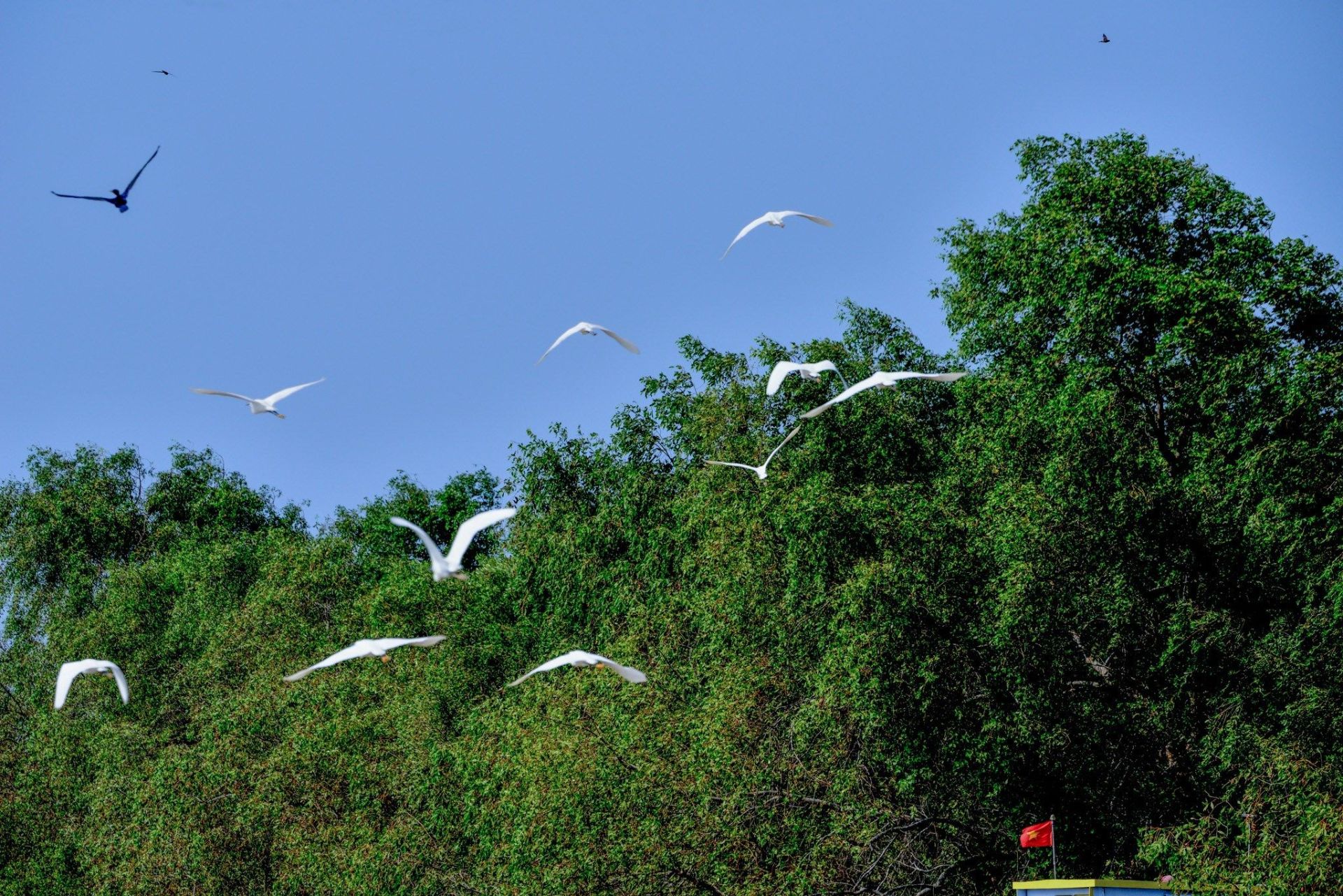
The area is often described as a bird sanctuary, but it functions as a multi-layered ecosystem. Mangrove species such as Rhizophora and Avicennia form dense root networks that anchor the soil. Mid-level vegetation supports insects and small animals, while open water zones connect the entire system through tidal movement.
Recorded biodiversity — over 200 plant species and more than 100 animal species — reflects how life adapts to these shifting conditions.
For student groups, what matters is not the numbers, but what those numbers represent: a system that continues to function because each layer supports the others.
What mangroves actually do
Mangroves are often introduced through their “importance,” but their role becomes clearer when observed directly.
First, they hold the land. Root systems slow wave energy, trap sediment, and reduce coastal erosion. In a delta under pressure from rising sea levels, this is not a background function — it determines whether coastlines remain stable.
Second, they support livelihoods. Beneath the roots, juvenile fish, shrimp, and crabs develop in sheltered conditions. This makes mangroves a natural nursery for local fisheries and a foundation for small-scale aquaculture.
Third, they store carbon. As part of “blue carbon” ecosystems, mangroves retain significant amounts of carbon in both biomass and soil. This connects local conservation directly to broader climate systems.
These roles are easier to understand when seen together, rather than as separate functions.
From ecosystem to livelihood: learning through Người Giữ Rừng
Within the same coastal context, models such as Người Giữ Rừng provide a closer view of how these systems are used.
Here, aquaculture takes place under the mangrove canopy. Shrimp and crabs are raised within a tidal system that depends on the health of the forest itself.
This creates a different relationship between people and environment. The forest is not protected by excluding human activity, but by making its survival economically necessary.
For students, this shifts the question. Sustainability is no longer about protecting nature in isolation, but about maintaining the balance that allows both the ecosystem and livelihoods to continue.
How this fits into a school trip
In most programs, coastal mangrove areas in the Mekong Delta — including sites like Vàm Hồ — are visited over a short segment, often within one day.
Compared to urban environments, the pace is slower and more observational. Activities typically involve moving through the forest by boat, walking along raised paths, and observing how the ecosystem functions at different levels.
These experiences are also dependent on timing, tidal conditions, and accessibility. What students are able to see can vary significantly based on when and how the visit is structured.
What students take away
Not every student leaves with a clear conclusion.
But many leave with a different understanding of how ecosystems work — not as isolated units, but as systems connected to land, water, and human activity.
Mangroves, in this context, are no longer just “forests.” They become systems that hold land, support livelihoods, and respond to environmental pressure at the same time.
A system that cannot be simplified
Mangrove ecosystems in the Mekong Delta are not easy to reduce to a single idea.
They are adaptive, layered, and dependent on balance.
That complexity is precisely what makes them valuable in educational programs.
Instead of presenting sustainability as a solved problem, they show it as an ongoing process — one that has to be observed, understood, and maintained over time.