
Most teachers begin planning by searching for a “Vietnam school trip itinerary.”
What they find is usually easy to read: a sequence of destinations, neatly arranged timelines, and full days that appear well-structured. On paper, it looks complete. But when it comes time to build a proposal or defend the plan internally, a different question emerges—will this actually run as intended, and will the learning hold across the day?
The issue is not a lack of information. It’s that many itineraries are designed to be read, not to be run. Questions about whether a program will actually run as intended are often closely tied to broader concerns about safety.
Where plans begin to slip
This gap becomes more noticeable in Vietnam. Movement is not always linear, and time does not scale predictably with distance. A short transfer on a map can take significantly longer in practice. At the same time, the context of the day can shift quickly—from dense, high-energy areas like the Old Quarter to more formal or historical spaces such as Ba Dinh.
Where this begins to show is in the transitions.
A group leaves one site expecting a short transfer. Traffic slows, or the vehicle cannot access the intended drop-off point, so the group walks further than planned. They arrive slightly late, and the next segment is shortened to compensate. By midday, the schedule is still technically intact—but the pace has tightened, and both energy and attention are already being stretched.
Nothing has failed outright, but the day is no longer holding in the way it was designed to.
Why many itineraries drift
What sits behind this pattern is consistent. This is a common dynamic across many Vietnam school trip itineraries. Programs try to cover too much within a structure that does not fully account for how the environment works. Days become overpacked, cities are treated as a series of attractions rather than lived systems, transition time is underestimated, and learning is tied to individual stops without a clear thread connecting them.
The program continues, but engagement becomes harder to sustain, and the experience begins to fragment.
What works in practice
A well-designed Vietnam school trip itinerary approaches structure differently.
Movement is organized by zone rather than by isolated points, reducing the need to cross the city multiple times in a single day. Cognitive load is managed more deliberately—students are not asked to absorb continuous input in an environment that is already dense with stimuli. Observation, guided activity, and reflection are sequenced so that learning can settle.
Each day also follows a clearer rhythm. Higher-intensity segments are balanced with lower-intensity periods and built-in reset points, particularly important in settings where heat, noise, and unfamiliarity can accelerate fatigue.
Strong itineraries anchor the day around one or two key learning moments. These are not necessarily the most prominent sites, but the experiences that carry meaning—where students have enough time and structure to engage, question, and reflect. In this context, depth tends to carry further than coverage.
A typical day
A typical day in Hanoi might reflect this approach: a focused morning walk through the Old Quarter with guided prompts, a midday pause long enough for the group to reset, and a single afternoon site explored in sufficient depth for the experience to land. Fewer transitions, but a more coherent flow of both movement and learning.
Where it falls short
Where itineraries tend to fall short is not in obvious ways. Everything may still run on schedule, but the day feels rushed, transitions feel strained, and key moments do not fully register. More often than not, this comes back to structure—too much has been packed in, or the design has not accounted for how the city actually operates.
For high school trips to Vietnam, the itinerary is not simply a list of places. It is what holds movement, timing, and learning together.
Vietnam does not remove complexity. It reveals whether a program has been designed to hold it. Designing the itinerary is only one part—being able to clearly explain and justify it is equally important.
If you are thinking through how this might translate into your own Vietnam school trip itinerary, it is often more effective to work from a structured draft than to build one from scratch. Some examples can be viewed here.
More latest news
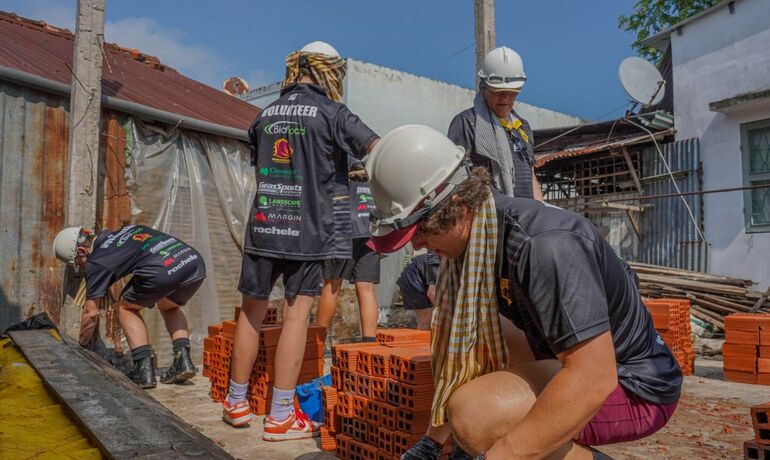
Vietnam School Group Tours & Service Learning Trips
Vietnam School Group Tours & Service Learning Trips Vietnam, a country of breathtaking landscapes, rich history, and diverse cultures, has become a sought-after destination for educational travel experiences. School group tours and service learning trips
Read more…
Ideas for School trip in Vietnam: Sapa and the North West
Sapa, a remote and enchanting destination nestled in the far northern reaches of Vietnam, presents a captivating landscape of rolling emerald hills, cascading waterfalls, and terraced rice fields that stretch into the horizon. This picturesque town,
Read more…
Exploring Educational Adventures - School Trips in Laos
Exploring Educational Adventures: School Trips in Laos Laos, a hidden gem in Southeast Asia, presents an incredible opportunity for educational school trips. This country boasts lush landscapes, serene temples, and a rich cultural heritage, making it an
Read more…