
Teachers are rarely the final decision-makers when proposing a Vietnam school trip.
In most cases, they are the ones building the case—but approval sits elsewhere. Parents want reassurance. School leadership wants clarity on structure, oversight, and risk. Much of that concern typically comes back to how safety is understood and managed in practice. What looks like a well-designed program on paper still has to be explained, defended, and, at times, questioned in detail.
This is often where the difficulty begins.
Where proposals get challenged
A teacher may feel confident in the value of the program—what students will experience, how they will grow from it—but that confidence is not always easy to translate in front of a room of parents. Questions tend to land in very specific places. How will students move through traffic? What happens if the schedule shifts? Who is responsible at each point of the day?
It is not that these questions are unexpected. It is that they require answers that are concrete, not conceptual.
Vietnam adds a layer of tension here. It is not a default destination, and it carries a higher level of perceived uncertainty. That puts teachers in a difficult position—trying to advocate for a program with strong educational value, while being asked to account for risks that feel harder to explain in simple terms.
What decisions are based on
What parents and administrators respond to, in practice, is less about the idea of the trip and more about how it holds under scrutiny.
General statements about “cultural exposure” or “global perspective” rarely carry much weight on their own. The questions tend to move quickly toward specifics: what students will actually be doing, how their time will be structured, and how the environment will be managed moment by moment.
Where justification breaks down
This is where many justifications start to lose clarity.
Not because the program lacks substance, but because the explanation stays too broad, or avoids the more difficult parts. Risk is acknowledged in principle, but not explained in practice. Structure is implied, but not made visible. The result is a proposal that sounds reasonable, but becomes harder to defend under follow-up questions.
What holds up in practice
What tends to work is a shift in how the program is presented.
Stronger proposals make the experience tangible. They describe what students will actually encounter—how they will move through a place like the Old Quarter, what they will be asked to observe, how activities are guided and processed. They also make clear why these experiences depend on being in that environment, rather than being replicated elsewhere.
Just as importantly, they address points of concern directly. Movement is explained in practical terms particularly in how daily movement and transitions are structured across the program. Supervision is clearly defined. There is visibility on who is managing the program on the ground, and how adjustments are made when conditions change. This does not remove uncertainty, but it shows that it is being actively handled.
Structure becomes the connecting piece.A Vietnam school trip is easier to support when the itinerary demonstrates not just where students go, but how the day holds together—something that is often reflected in how a Vietnam school trip itinerary is designed in practice.
Reframing the destination
In that context, Vietnam itself no longer needs to be “framed” as exceptional. It can be described more plainly: an environment that requires a different level of attention and adaptation, and therefore creates different kinds of learning. Not because it is inherently better, but because it engages students in ways that are harder to simulate in more controlled settings.
What approval depends on
For high school trips to Vietnam, approval rarely comes from how compelling the destination sounds in isolation.
It comes from whether the program can be clearly explained, and whether it continues to hold when questions become more specific.
That does not usually resolve every concern. But it shifts the conversation—from uncertainty that is difficult to assess, to something more concrete that can be considered, discussed, and, in many cases, supported.

More latest news
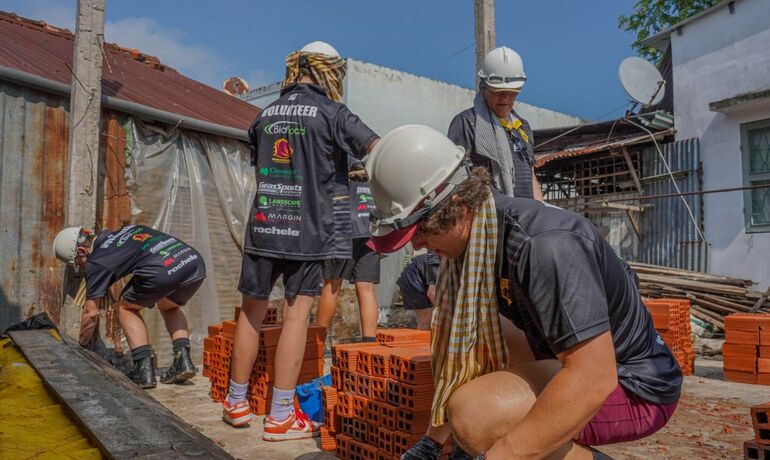
Vietnam School Group Tours & Service Learning Trips
Vietnam School Group Tours & Service Learning Trips Vietnam, a country of breathtaking landscapes, rich history, and diverse cultures, has become a sought-after destination for educational travel experiences. School group tours and service learning trips
Read more…
Ideas for School trip in Vietnam: Sapa and the North West
Sapa, a remote and enchanting destination nestled in the far northern reaches of Vietnam, presents a captivating landscape of rolling emerald hills, cascading waterfalls, and terraced rice fields that stretch into the horizon. This picturesque town,
Read more…
Exploring Educational Adventures - School Trips in Laos
Exploring Educational Adventures: School Trips in Laos Laos, a hidden gem in Southeast Asia, presents an incredible opportunity for educational school trips. This country boasts lush landscapes, serene temples, and a rich cultural heritage, making it an
Read more…