Designing for attention and student engagement in school trips — A practical approach to experiential learning
In many school trips and educational travel programs, the focus is often placed on itinerary design — where students go, what they do, and how each day is structured. These elements matter. But they do not fully explain why some moments stay with students long after the trip, while others fade quickly.
This is often discussed in terms of student engagement in experiential learning. Yet in practice, engagement may depend on something more fundamental — how students pay attention to what is happening around them.
Attention as a design consideration
Some moments on a trip stay with students longer than others. Not because they are larger or more eventful, but because of how they are experienced in real time.
Earlier this year, the Walk for Peace movement offered a useful reference point. Its premise was simple: slow down, pay attention, and observe without reacting too quickly. We adapted that idea into a small, practical anchor for one of our school trips: “Today’s going to be a peaceful day.” It was not intended as a slogan, but as a light framing for how students approached each day.
The structure of the program did not change. The same locations, the same sequence of activities. What shifted was how students entered those experiences — how they paid attention and engaged with what was unfolding.
Minimal framing, maximum context
Rather than adding more explanation, the approach was to reduce it.
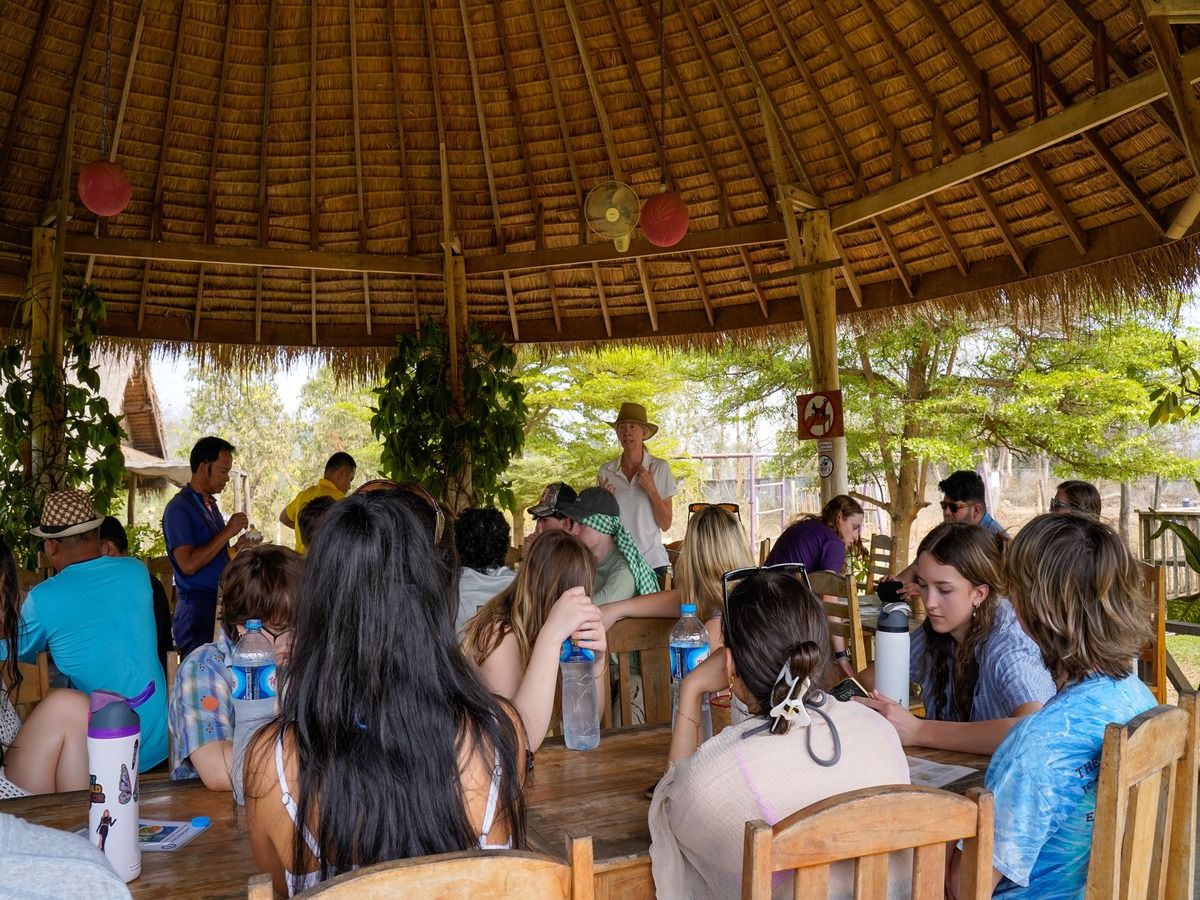
Each day began with a brief orientation — just enough to set the tone — followed by space for the environment to take over. In this sense, experiential learning was less about directing interpretation, and more about allowing students to engage with context as it is.
One morning, students participated in an alms-giving ritual. They joined from the beginning, moving alongside local residents. The pace of the ritual, the repetition, and the quietness shaped the experience without the need for detailed instruction. Students began to adjust on their own — lowering their voices, paying attention to timing, and becoming more aware of how to be present without disrupting what was already taking place.
A similar dynamic appeared in temple visits. Guidance was intentionally minimal, limited to avoiding obvious missteps. Beyond that, the setting itself provided cues. Students observed how others moved, where they stood, and when to act. These patterns were not explicitly explained, but they were still understood.
What students begin to notice
This approach is not highly structured, but it changes how students pay attention.
Instead of being told what something means, students begin by noticing how it feels, how it unfolds, and how they fit into it. Engagement comes later, grounded in what they have actually observed.
Over time, this shows up in small but consistent ways. Students pause slightly longer before reacting. They notice details they might otherwise miss. They become more comfortable sitting with situations that are not immediately clear.
Designing less, holding more
From a program design perspective, this does not require adding complexity. If anything, it involves restraint.
Designing for attention and student engagement in school trips is less about layering additional activities, and more about calibrating how much guidance is given — and when. Too much structure can close off observation; too little can leave students without orientation. The balance lies in creating just enough framing for students to enter a context, and then allowing that context to shape the experience.
In educational travel programs, this often means trusting that the environment itself carries a form of structure — one that students can begin to read if given the space to do so.
What tends to stay
The change is not always immediately visible. But over time, these moments tend to stay with students in ways that more structured experiences do not.
They are not necessarily the most memorable in the conventional sense. They are the moments where attention was held long enough for something to register more deeply.
In practice, what we often call student engagement may begin with how attention is shaped in the first place. In that sense, designing for attention is not separate from designing for engagement — it is what allows engagement to happen.
Written by: Scivi Program Development - High School Team

More latest news

Mekong Delta for Vietnam service learning — what actually happens on the ground
Service learning in the Mekong Delta often looks straightforward on paper, but the reality is more complex. This article outlines what students actually do, the constraints they face, and how their experience evolves over the course of a typical program
Read more…
Best destinations for school trips in Vietnam — and what students actually learn in each
Choosing destinations is one of the first decisions in designing a school trip to Vietnam. This article looks at how key locations shape experiential learning, student engagement, and overall program outcomes.
Read more…
Designing school trips to Vietnam: from destinations to learning context
Where students go on a school trip matters more than is often acknowledged. In Vietnam, destinations shape not only engagement, but also how experiential learning unfolds in practice.
Read more…